

Industry 4.0
Industrial digital transformation and Industry 4.0
In Industry 4.0, quality is the core of high-tech manufacturing, and our solutions start with quality. We connect industrial assets, people and processes to a single data infrastructure that turns operational data into decisions.
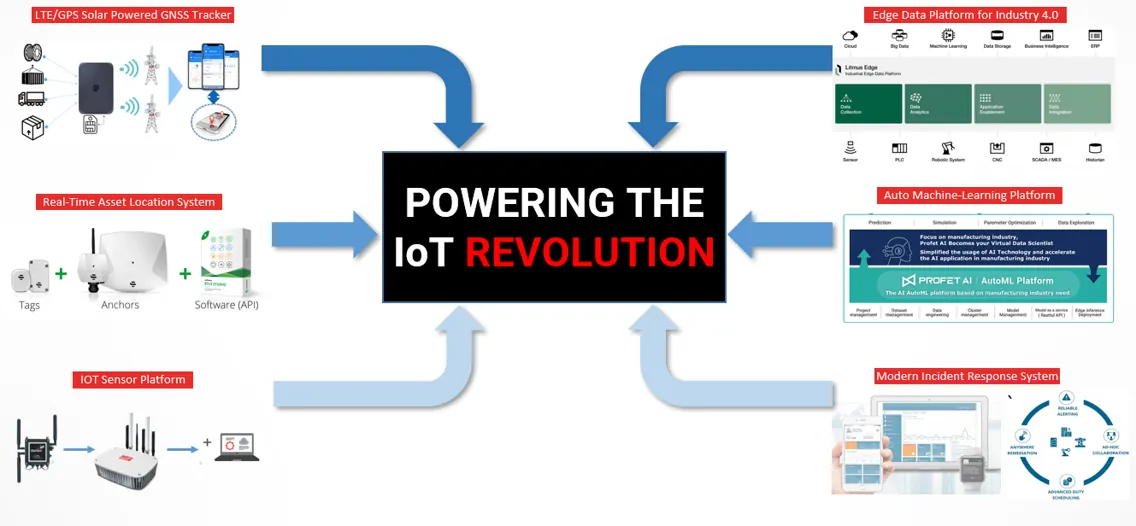
Powering the IoT revolution
Six building blocks we combine to digitise industrial operations. Each can be deployed on its own or as part of a wider programme.
LTE/GPS solar-powered GNSS tracker
Track containers, vehicles and goods across sites and in transit, with data delivered to mobile and web applications.
Real-time asset location system
Tags, anchors and API-driven software that locate people and assets indoors in real time.
IoT sensor platform
Gateways and sensors that capture field data and deliver it to your applications and dashboards.
Edge data platform for Industry 4.0
Connect PLCs, CNC, SCADA/MES and historians at the edge for data collection, analytics and integration.
Auto machine-learning platform
Profet AI AutoML: an AI platform for manufacturing covering prediction, simulation, parameter optimisation and data exploration.
Modern incident response system
Reliable alerting, ad-hoc collaboration, advanced duty scheduling and anywhere remediation.
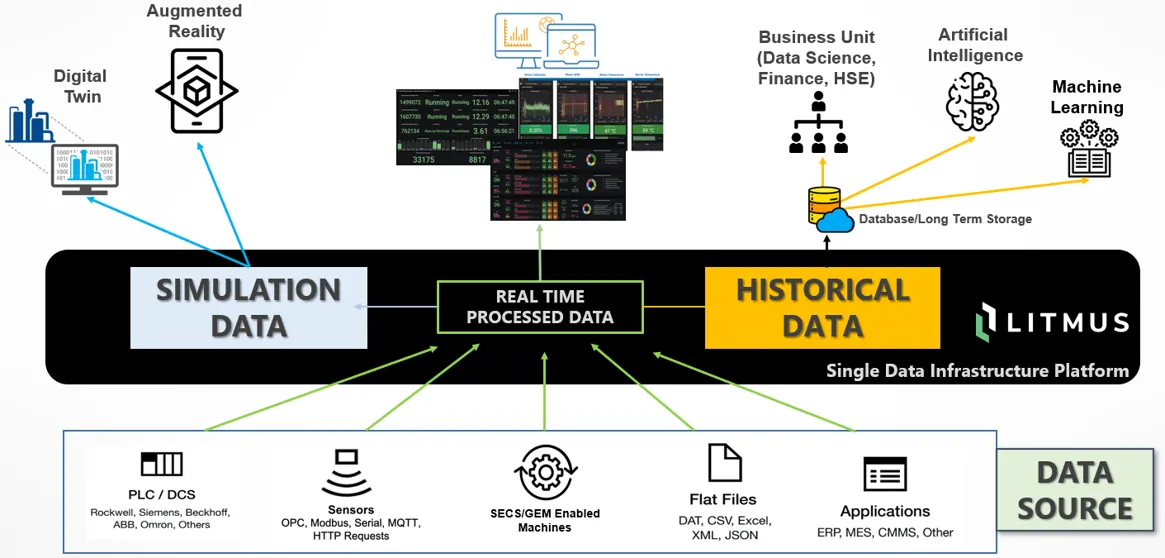
One data infrastructure for the plant
Data from PLCs and DCS (Rockwell, Siemens, Beckhoff, ABB, Omron and others), sensors (OPC, Modbus, serial, MQTT, HTTP), SECS/GEM-enabled machines, flat files and applications such as ERP, MES and CMMS flows into a single platform.
- Real-time processed data drives live dashboards on the shop floor.
- Simulation data feeds digital twins and augmented reality.
- Historical data in long-term storage supports business units, data science, finance, HSE, AI and machine learning.
Data Industry 4.0 (d.i.4.0)
A quality-first framework for Industry 4.0
Data Industry 4.0 is a Macrovention subsidiary established in 2014 in response to the growing Industry 4.0 trend. Its vision is to become the leading Industry 4.0 consulting practice in the region, and its mission is to help clients reach clarity through data-driven methods and prepare for Industry 4.0 readiness.
Technology comes second to a strong foundation
The d.i.4.0 framework rests on quality. Established quality frameworks used in high-tech manufacturing, such as Kaizen, 5S and Six Sigma, with a focus on delivery and operations, underpin the nine technology pillars of Industry 4.0. Horizontal and vertical systems include Kaizen, QRQC, 5S and safety, and IN-10-TIONS.
Our client base is growing, we partner with other leading solution providers, and we are expanding beyond high-tech manufacturing into oil and gas.
The nine pillars of Industry 4.0
- Autonomous robots
- Internet of Things
- Cybersecurity
- Simulation
- Big data and analytics
- Augmented reality
- Additive manufacturing
- The cloud
- Horizontal and vertical system integration
Delivery methodology
Technical assessment
A subject-matter expert assesses your operations, followed by a tailored assessment and deeper audit.
Roadmap 4.0
Development plans that set out how your operation moves toward Industry 4.0.
Implementation
Technologies and digital transformation methods are deployed, connecting machines, sensors and devices to collect data.
4.0 readiness
Manufacturing data is processed into insight, using platforms such as Splunk.
Related products
Talk to Macrovention
Start with an Industry 4.0 assessment
We begin every industrial engagement with a technical assessment of your operation, then build a roadmap you can act on.